Guest User

Ax-2 crew completes Human Exploration Research Analog mission

The four crew members of Axiom Mission 2, called Ax-2, are inside the HERA habitat at NASA's JSC. The photo captures their smiling faces as they look down from the second floor of the habitat.

The Ax-2 crew members - Whitson, Shoffner, Barnawi, and AlQarni - inside of the HERA habitat.

To simulate their 12 days in space, the crew of Ax-2 participated in the Human Exploration Research Analog (HERA), a training program designed to push people to the extremes and intended to prepare this team for their mission to orbit.  

Ax-2 crew members spent about a week inside the HERA habitat, a unique 650-square-foot three-story structure at NASA Johnson Space Center. The habitat serves as a ground-based analog for isolation, confinement, and remote conditions in exploration scenarios. 

As part of HERA, the Axiom Space Mission Integration and Operations (MI&O) team planned a space mission similar to what the crew will experience on Ax-2. Focused on completing several key objectives, crew members worked on completing tasks on their timeliness and trained on equipment and procedures they will be using when they visit the International Space Station. The crew worked through emergency scenarios and participated in team-building exercises ahead of their historic mission.   

As a big focus of the mission is on inspiring students and STEAM engagement; the crew was excited to be part of a live outreach event speaking directly with the children of Axiom Space employees who asked curious questions about space and life as an astronaut.  

The four crew members of Axiom Mission 2, called Ax-2, stand side-by-side inside the HERA habitat at NASA's JSC.

The Ax-2 crew members - (left to right) John Shoffner, Rayyanah Barnawi , Peggy Whitson and Ali AlQarni - inside of the HERA habitat.

Ax-2 commander Peggy Whitson

Ax-2 mission specialist Rayyanah Barnawi

Ax-2 pilot, John Shoffner, and Ax-2 commander, Peggy Whitson, inside of the HERA habitat.

A young boy asks a question into a mic. The Ax-2 astronauts took questions from children of Axiom Space employees during the HERA mission.

The Ax-2 astronauts took questions from children of Axiom Space employees during the HERA mission.

A young girl, the daughter of an Axiom Space employee, looks at a computer screen seeing live images of the Ax-2 astronauts as she and other children ask questions. The Ax-2 astronauts participated in the HERA mission.

A young girl, daughter to an Axiom Space employee, asks the Ax-2 astronauts a question while they participate in the HERA mission.


Axiom Space releases patch for Ax-2 Crew, second private crew to ISS

Axiom Mission 2 (Ax-2) is the second private astronaut mission to the International Space Station (ISS) and, furthers Axiom Space’s mission to improve life on Earth and foster possibilities beyond it by building and operating the world's first commercial space station. 

The Ax-2 mission patch highlights the beauty of space, hope for the future, and the important role of the ISS to unite the best aspects of humanity. The Ax-2 patch is a classic triangular shape, which represents stability and power.  

A sea of bright stars and constellations shine through the black canvas honoring the mission’s focus on inspiration, education and teaching, symbolized by the five S.T.E.A.M symbols. Science represented by a DNA strand, Technology represented by a set of connected circles, Engineering represented by a cog, Arts represented by a brush, and Math represented by the Pi symbol. 

At the center of the patch is the ISS with a lavender ascent and path from Earth to space.

The color lavender has a special cultural meaning in the Kingdom of Saudi Arabia (KSA), representing the color of the nation’s deserts and plateaus in the spring when they are covered in flower blooms. Lavender is also the color used in KSA’s ceremonial events and a symbol of hospitality. In the patch, the color reflects the nation’s desire to be a part of the space sector and position itself as a contributor to the global space community. 

Linear lines inside the lavender path represent the motion used to reach the ISS. The technical style visually expresses the cutting-edge technology of the mission. There are five lines, which represent the five pillars of S.T.E.A.M. with each line representing education: science, technology, engineering, the arts, and mathematics.

At the bottom of the patch is, the Earth and the horizon, which symbolize hope and inspiration. The bright white and energetic orange colors denote the optimism of Axiom Space’s effort to expand access to low Earth orbit. 

Surrounding the inner components of the patch, are the flags of the two countries flying as part of the Ax-2 mission, Commander Peggy Whitson and, Pilot John Schoffner of the United States of America, and the two Mission Specialists, Ali AlQarni and Rayyanah Barnawi from the Kingdom of Saudi Arabia, who are members of the inaugural Saudi national astronaut program. Together, the four crew members make up the second private astronaut mission to the ISS, a mission that is expanding access to low-Earth orbit for individuals and nations around the world. 

Visit the Axiom Space store at merch.axiomspace.com to purchase Ax-2 merchandise.

Axiom Space Offers VR Experience of Axiom Station during IAC Special Session (VIDEO)

Exclusive sneak-peak at Axiom Station

(PARIS) - Axiom Space today debuted an innovative session at the International Astronautical Congress (IAC) in Paris providing a virtual tour of Axiom Station, the world’s first commercial space station.  Making use of Axiom’s industrial and design and engineering models, Axiom leaders used virtual reality technology to guide the audience through an interactive video of Axiom’s in-production space station.

Outfitted with headsets and projecting their field of vision onto a large screen for the audience, Axiom leaders Chief Technology Officer Matt Ondler, Executive Vice President of In-Space Manufacturing Christian Maender, and Chief Astronaut Michael Lopez-Alegria, demonstrated design features of the company’s commercial space station. The first module of Axiom station is currently planned for launch in the mid-2020’s to attach to the ISS.

In collaboration with her colleagues, the session was created by Dr. Mary Lynne Dittmar, Chief of Government and External Affairs, who welcomed the audience and worked with the team to answer questions. Axiom’s industrial and VR designers Kelsey Kim and Corey Smith were on hand and highlighted Axioms’ innovative methods of design and development.

The exclusive special sneak peek included Ondler’s overview of the construction and development of Axiom Station. Maender provided a tour of Axiom's research and manufacturing module and previewed  the unique scientific and manufacturing capabilities of the commercial space station. Lopez-Alegria took the audience on a virtual spacewalk around Axiom Station, explaining the various design elements and future experience for Axiom astronauts, including a look out of Axiom’s Earth observatory cupola, eight of the largest windows ever constructed for the space environment with breathtaking views of planet Earth.

The audience was then invited to participate in the session with questions and ideas.  Several audience members donned the Axiom virtual reality headsets and toured the station for themselves, with their journey projected to all in attendance.

The step-by-step narration of Axiom Station design and capabilities was an exclusive “out of this world experience for the IAC attendees.  Below is a short clip of Lopez-Alegria flying to Axiom’s earth observatory cupola.

Former National Space Council Official, Jared Stout, Joins Axiom Space Government Relations Team

Jared Stout

Commercial space leader Axiom Space is pleased to announce the hire of Jared Stout, formerly the Deputy Executive Secretary and Chief of Staff of the White House National Space Council, to serve as the company’s Vice President of Government and External Relations, beginning on August 15.  At Axiom, which is currently constructing the world’s first commercial space station to succeed the International Space Station (ISS), Mr. Stout will oversee advocacy and outreach initiatives and serve as a thought leader for the company’s policy objectives spanning the U.S. Government as well as state and regional activities. 

Stout joins Axiom from Meeks, Butera & Israel, PLLC in Washington, D.C., where he has been Director of Congressional and Regulatory Policy for the past two years after an earlier role as Senior Policy Advisor at Venable, LLP.  In those positions he served as a key advisor shaping legislative, communications, and regulatory strategies for clients spanning the civil, commercial, and national security space industry. His prior work with the National Space Council included orchestration of external affairs for the Council and formulation of U.S. national space policy and initiatives, working across the entire U.S. Government through the interagency process to coordinate space policy in the civil, commercial, and national security sectors.

“I am thrilled to be joining Axiom Space and a leadership team that is driving economic development in low-Earth orbit”, said Stout.  “Axiom’s recent, successful Ax-1 mission together with several recent international agreements and strong progress manufacturing Axiom Station position it as the key architect of the next generation of human activity in space, providing orbital infrastructure services to industry, researchers, international teams and the U.S. Government through new and innovative business relationships.”

Prior to joining the National Space Council staff, Stout was Chief of Staff at the Federal Aviation Administration’s Office of Commercial Space Transportation, where he had earlier served as Senior Advisor for Communications.  Before joining the FAA, he was a Professional Staff Member supporting the Space Subcommittee of the Science, Space and Technology Committee of the House of Representatives, where he drafted significant portions of NASA Authorization Acts and the U.S. Commercial Space Launch Competitiveness Act of 2015, among others.

Stout’s addition to Axiom bolsters an organization with deep expertise in commercial space, spanning engineering, research, manufacturing, and policy.  He will report directly to Dr. Mary Lynne Dittmar, Chief Government and External Relations Officer for Axiom.

“Jared brings a tremendous range of space policy development, industry expertise, advocacy, and strategic vision encompassing relationships and experience in both the legislative and executive branches of the federal government as well as state operations,” said Dittmar. “Axiom is completely committed to preserving U.S. leadership in space through commercial partnerships and our relationship with NASA, as well as through a whole-of-government approach that Jared played a key role in advancing at the federal level.  We look forward to welcoming him to the Axiom team.” 


About Axiom Space:
Axiom Space is guided by the vision of a thriving home in space that benefits every human, everywhere. The leading provider of human spaceflight services and developer of human-rated space infrastructure, Axiom operates end-to-end missions to the International Space Station today while privately building its successor, Axiom Station, the first permanent commercial destination in Earth's orbit that will sustain human growth off the planet and bring untold benefits back home.

###

Axiom Space and Hungary Sign MOU To Expand Relationship in Space

Michael Suffredini, President and CEO of Axiom Space, and Mr. Péter Szijjártó, Minister of Foreign Affairs and Trade of Hungary, sign a memorandum of understanding (MOU) in Washington D.C. on July 20, 2022. (Credit: Márton Király)

Axiom Space and the Hungarian government’s Ministry of Foreign Affairs and Trade have signed a memorandum of understanding (MOU) to further their existing relationship in human spaceflight and to advance opportunities in space research and technology development. The agreement between Axiom and Hungary was signed on July 20, 2022,  in Washington, D.C.  

The main focus of the new agreement is to further the Hungarian to Orbit (HUNOR) program, Hungary’s astronaut program, which aims to send a Hungarian astronaut to the International Space Station (ISS) via a future Axiom Space commercial astronaut mission. Building off the first agreement between Axiom and the Hungarian government, signed on December of 2021, which formalized a partnership to return a Hungarian astronaut to space, this MOU enables a wide range of cooperation and possible joint developments between Axiom Space and Hungary. It acknowledges both the importance the company plays in helping to define the future of human space flight, including through the future Axiom Station, as well as the capacities and space heritage of the Hungarian space sector.

“As we enter this new era of commercial spaceflight, it is vital that the U.S. space industry continues forging relationships with nations committed to collaborating in microgravity research and bringing those benefits back to the people of Earth. The U.S. has a long history of international cooperation in space, bringing countries together for the purpose of benefiting all humans, everywhere,” said Michael Suffredini, President and CEO of Axiom Space

“This second agreement between Hungary and Axiom Space builds on efforts to cultivate a robust economy in space by engaging government and industry partnerships. Such collaborations have the power to transform what was once only imaginable,” said Suffredini. “We look forward to expanding our relationship with Hungary to include new initiatives in human spaceflight, science, and STEM.”

This new agreement underscores Axiom Space and Hungary’s common interest to utilize space for peaceful purposes and promote scientific advancement through international collaboration. Under this agreement, Axiom and Hungary will collaborate to enable scientific research and technology demonstrations in microgravity, develop in-space manufacturing capabilities, and inspire the next generation of a strong and capable STEM workforce.

“This partnership with Axiom Space is an important investment that will provide opportunities conduct research in microgravity, strengthen the Hungarian Astronaut Program, and enhance Hungary’s work towards advancing space research and technology development. Together, we are confident that the space industry will play a crucial role in the development of our economy and are both committed to investing into this high-tech and knowledge-based sector. The adoption of the first Hungarian governmental Space Strategy that was established last year signifies our commitment towards expanding our involvement and presence in space.” said Péter Szijjártó, Minister of Foreign Affairs and Trade of Hungary.

The growing relationship between Axiom Space and Hungary symbolizes the company’s commitment to provide opportunities to nations across the globe who share an appreciation for the benefits provided by microgravity while strengthening bonds between nations and the world at-large.

About Axiom Space

Axiom Space is guided by the vision of a thriving home in space that benefits every human, everywhere. The leading provider of human spaceflight services and developer of human-rated space infrastructure, Axiom operates end-to-end missions to the International Space Station today while privately building its successor, Axiom Station, the first permanent commercial destination in Earth's orbit that will sustain human growth off the planet and bring untold benefits back home.

Axiom Space wins NASA Contract to Build Next Generation Astronaut Spacesuits

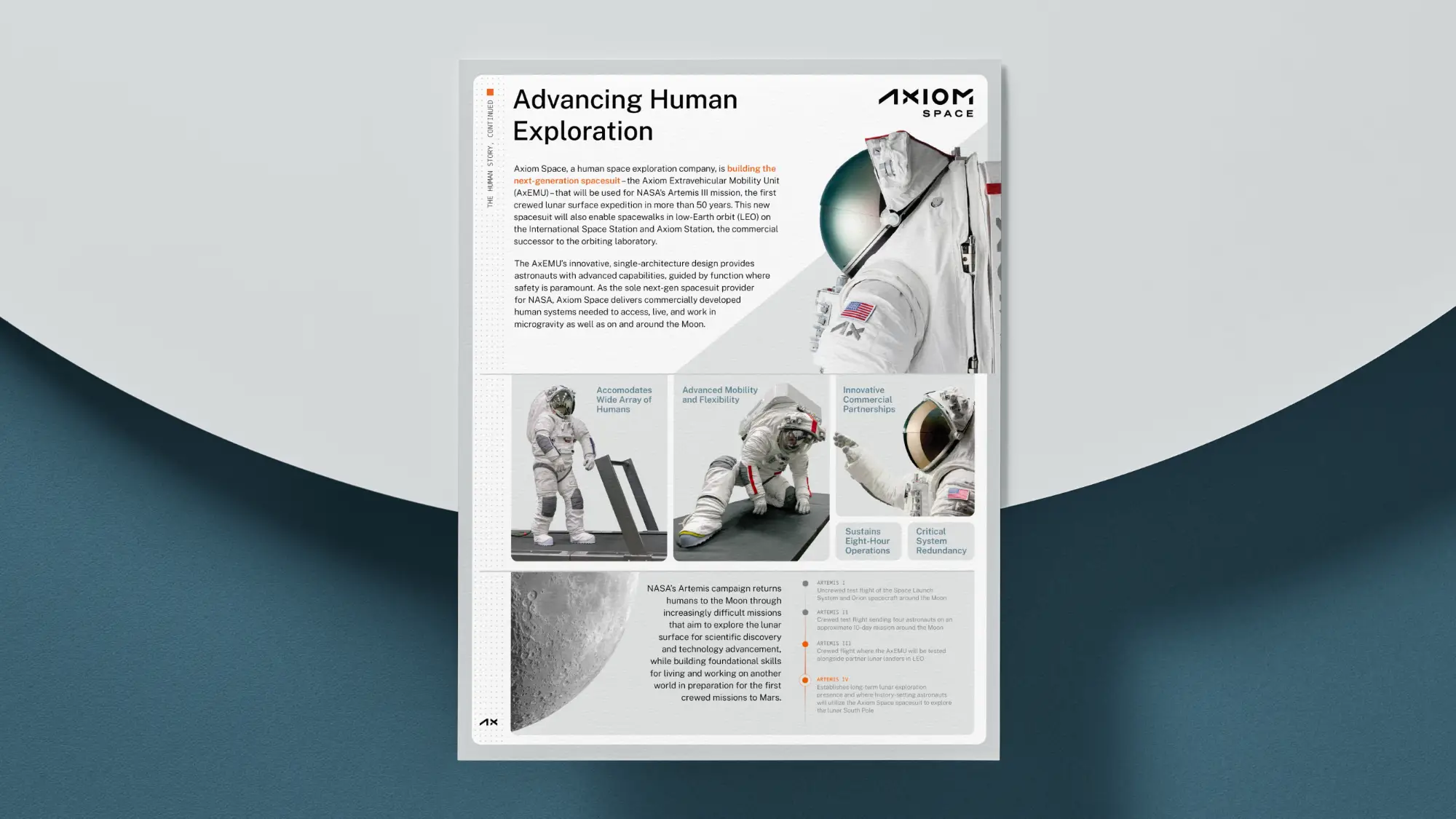
HOUSTON - Axiom Space announced today that it has been awarded the NASA Extravehicular Activity Services (xEVAS) Contract. Axiom is one of two companies to win the award with a potential total value of $3.5 billion across the life of the program. Under the terms of the contract, the Houston-based company will build the space agency’s next generation astronaut spacesuits that may be used for low Earth Orbit (LEO) and the Artemis lunar missions. The new spacesuits by Axiom Space will provide astronauts with advanced capabilities for space exploration while providing NASA commercially developed human systems needed to access, live, and work in microgravity and on and around the Moon.

The Axiom spacesuit is key to the company’s commercial space services. This new NASA contract enables Axiom to build spacesuits that serve the company’s commercial customers and future space station goals while meeting NASA’s ISS and exploration needs.   

“Our innovative approach to xEVAS spacesuits provides NASA with an evolvable design that enables cost-efficient development, testing, training, deployment, and real-time operations to address a variety of EVA needs and operational scenarios for a range of customers, including NASA,” said Michael Suffredini, Axiom Space’s President & CEO. “We are immensely pleased that NASA recognizes the value Axiom Space is providing across a range of human spaceflight activities, from our recent private astronaut mission to the ISS to the design and development of Axiom Station, and now to providing this critical system and associated services for astronauts in LEO and beyond.”

Members of Axiom Space’s Extravehicular Mobility Unit (AxEMU) work on building the next generation spacesuit at the company’s Houston headquarters. Photo credit: Axiom Space 

Axiom Space has partnered with a strong team of industry experts on this contract including KBR, Air-Lock, David Clark Company, Paragon Space Development Corporation, Sophic Synergistics, and A-P-T Research.

The firm fixed price contract is structured as an Indefinite Delivery Indefinite Quantity (IDIQ) award over a 10-year ordering period and allows for two additional years for completion of services. Authorization to perform work under the xEVAS contract will be through the issuance of NASA task orders not to exceed $3.1B with a ceiling of $3.5B for all services.

Axiom’s xEVAS spacesuits will be designed to accommodate a wide range of crew members. Building off of NASA’s xEMU spacesuit design, the Axiom spacesuits are created to provide increased flexibility and specialized tools to accomplish exploration needs and expand scientific opportunities in space. The xEVAS spacesuits design includes life support, pressure garments, and avionics. The Axiom Space team will provide EVA systems training and real-time operations support to NASA, among other services.

NASA may order IDIQ services at any time after the contract starts with a period of performance beginning June 2022 and ending June 2032.  No phase-in period is anticipated, and the work will be managed at Axiom’s Houston facilities.

This NASA contract win is the latest of Axiom Space’s list of recent accomplishments in its efforts to grow the commercial space industry. Earlier this month Axiom Space celebrated the groundbreaking at the company’s new, long-term headquarters at Houston Spaceport, which will be home to the development and construction of Axiom Station, the world’s first commercial space station. Axiom Space also recently welcomed home the crew of Axiom Mission 1 (Ax-1) after successfully completing the first all-private astronaut mission to the ISS. The company has also signed agreements with several nations including Italy, Hungary, and the United Arab Emirates (UAE) to fly on future space missions.

Axiom Space was founded in Houston in 2016 by space entrepreneur Kam Ghaffarian and Michael Suffredini – NASA’s ISS Program Manager from 2005 to 2015 –   to build the world’s first commercial space station and develop commercial space infrastructure that will drive a thriving low-Earth orbit economy. The company currently employs more than 500 people, the majority of which work at its current Houston facilities and will grow the number to over 1,000 by 2023.

This patch represents the Axiom Space’s Extravehicular Mobility Unit (AxEMU). Our blue star represents Ed White, the first American to perform an EVA. The red star represents Alexie Leonov, the first person to conduct a spacewalk. Each white star represents our AxEMU sub-system team. The gray path illustrates our continuous improvement in engineering design. The orange streak represents leveraging commercial EVA services for NASA’s exploration missions.


About Axiom Space  

Axiom Space, the premier provider of human spaceflight services and developer of human-rated space infrastructure, is guided by the vision of a thriving home in space that benefits every human, everywhere. Axiom is opening new markets in low-Earth orbit through operating end-to-end missions to the International Space Station while privately developing its successor – a permanent commercial destination in Earth’s orbit that will sustain human growth off the planet and bring untold benefits back home.

Inquiries: media@axiomspace.com   

Axiom Space and the Mohammed bin Rashid Space Center Sign Agreement for UAE Astronaut to Fly on the ISS in 2023

Axiom Space is opening low Earth orbit to the broader international community by enabling the first long-duration flight for an astronaut from the United Arab Emirates (UAE). The Mohammed bin Rashid Space Centre (MBRSC) signed a new strategic cooperation in human spaceflight with Axiom Space Inc. announcing the launch of a new space mission to the International Space Station that will last for six months. The agreement between MBRSC and Axiom Space was signed at the Embassy of the United Arab Emirates in Washington D.C. on April 27 , and His Excellency Yousef Al Otaiba, UAE Ambassador to the United States, H.E. Hamad Obaid Al Mansoori, Chairman, MBRSC, and H.E. Yousuf Hamad AlShaibani, Deputy Chairman, MBRSC, along with astronauts Nora AlMatrooshi and Mohammed Al Mulla all attended the signing ceremony. The agreement was signed in the Embassy of the United States by both parties: H.E Salem Al-Marri, Director General of the Centre, on behalf of the Centre, and Michael Suffredini, President and CEO of Axiom Space.

HOUSTON, 29 April 2022 – The exciting new era of commercial human spaceflight ushered in over the past three weeks by the successful Axiom Mission 1 (Ax-1), the first private mission to the International Space Station (ISS), entered a new phase with the signing of an agreement between Axiom Space and the Mohammed bin Rashid Space Center (MBRSC) of the United Arab Emirates (UAE) to fly a UAE professional crew member to the ISS on NASA’s SpaceX Crew 6, expected to occur in 2023.

“It is our great pleasure to sign the agreement with the United Arab Emirates’ Mohammed bin Rashid Space Center, marking the first time a commercial space company has made such a mission possible,” said Michael Suffredini, President and CEO of Axiom Space. “Axiom Space is proud to provide MBRSC with a flight opportunity for a UAE astronaut, enabling its first long-term mission to the ISS.”

While UAE has previously flown an astronaut to the ISS onboard the Soyuz MS15 spacecraft, this will be the first non-ISS partner professional astronaut flight facilitated by a U.S. commercial space company. The mission is expected to last approximately six months, marking the first long-duration flight of an astronaut from an Arab nation. In yet another first, the UAE crew member will serve as a member of two Expedition crews onboard the space station across the roughly six-month interval. 

The flight opportunity provided by Axiom has its origins in a no-funds contract signed between NASA and Axiom to fly a NASA astronaut onboard a Soyuz seat, previously purchased by Axiom, in order to ensure continuous U.S. presence onboard the ISS. In exchange, NASA provided Axiom the right to use a seat owned by NASA onboard a commercial U.S. spacecraft traveling to the ISS in the future. Since the seats were deemed of equal value, there will be no future exchange of funds between NASA and Axiom for the flight opportunity. Axiom’s agreement with MBRSC is between the company and the UAE space agency.

The agreement was signed at the Embassy of the United Arab Emirates in Washington, D.C., on April 27 by Salem Humaid AlMarri, Director-General of MBRSC, and Michael Suffredini, and announced by His Highness Sheikh Mohammed Bin Rashid Al Maktoum, Vice President and Prime Minister of the UAE and Ruler of Dubai. 

About Axiom Space

Axiom Space is guided by the vision of a thriving home in space that benefits every human, everywhere. The leading provider of human spaceflight services and developer of human-rated space infrastructure, Axiom operates end-to-end missions to the International Space Station today while privately building its successor, Axiom Station, the first permanent commercial destination in Earth's orbit that will sustain human growth off the planet and bring untold benefits back home.

Inquiries: media@axiomspace.com

Axiom Space’s First All-Private Astronaut Crew Returns From 17 Days on The International Space Station

courtesy of SpaceX

HOUSTON 25 April 2022 - The Axiom Mission 1 (Ax-1) crew and the SpaceX Dragon spacecraft safely splashed down off the coast of Florida at 1:06 p.m. ET, Monday, April 25. The Ax-1 crew’s arrival back to Earth officially concludes the first all-private astronaut mission to the International Space Station (ISS), successfully demonstrating Axiom Space’s ability to integrate with the ISS and conduct meaningful research.   

During their 17-day mission, Ax-1 Commander Michael López-Alegría, Pilot Larry Connor, and Mission Specialists Eytan Stibbe and Mark Pathy worked aboard the orbiting laboratory for 15 days. They flew approximately 6.3 million miles, about 240 orbits of Earth. Among the many highlights:  

  • Ax-1 supported 26 science payloads and technology demonstrations that had been curated with leading academic and research partners around the globe, including the Mayo Clinic, Montreal Children’s Hospital, Cleveland Clinic, and the Ramon Foundation, as well as research investigations from Axiom’s partners such as studying self-assembling technology for future space habitats, devices to purify air on space stations, and more;  

  • The Axiom astronauts served as research subjects to better understand the impacts of microgravity on the human body, as well as methods for maintaining connectedness to loved ones on Earth during space travel; and   

  • The Ax-1 crew shared the excitement of expanded access to space with a new generation of space explorers, participating in over 30 STEAM (science, technology, engineering, art and math) engagements. Outreach efforts were conducted in English, Hebrew, Spanish, French, and Arabic  

In keeping with the mission’s emphasis on scientific discovery, within hours of splashdown and recovery, the astronauts will take part in post-flight studies such as providing biomedical and physiological data for researchers at the Translational Research Institute for Space Health to gauge the effects of spaceflight on the human body, including changes in vision, balance, and perception. 

“Axiom Space is incredibly proud of this mission and these astronauts, whose training rigor and commitment to a robust research portfolio set the standard for future private spaceflight,” said Michael Suffredini, President and CEO of Axiom Space. “The Ax-1 mission is a pathfinder, showing the value of this new method of access to orbit and progress toward Axiom Station, a next generation platform in which the benefits and products of life, work and research in space will be available to a greater number of people.”   

Ax-1 is the first of several planned Axiom missions to the ISS and is an important step for Axiom Station, the first commercial space station that will serve as a global academic and commercial hub. The success of Ax-1 provides valuable insight as Axiom Space works toward Axiom Mission 2 (Ax-2), the details of which Axiom Space is negotiating with NASA.  

“The success of this first private astronaut mission to the International Space Station is an important step in opening opportunities for space travelers and achieving NASA’s goal of enabling commercial business off the planet in low-Earth orbit,” said NASA Administrator Bill Nelson. “This progress has been made possible by NASA’s work with private industry – especially the Commercial Crew Program. I’m incredibly proud of the NASA, SpaceX, and Axiom teams for safely completing this landmark mission. Welcome home, Ax-1!”  

SpaceX’s Falcon 9 launched Dragon and the Ax-1 crew to the ISS on Friday, April 8. Seventeen days later, Dragon and the Ax-1 crew undocked from the space station at 9:10 p.m. ET, Sunday April 24. The Ax-1 mission, the first all-private mission with a commercial spacecraft, highlights the important role of commercial companies to expand access to low-Earth orbit. Ax-1 represents the first of four private human spaceflights that Axiom Space has contracted with SpaceX to transport the crew to and from the orbiting laboratory.

The crew provided the following statements on their return:  

Michael López-Alegría, Ax-1 Commander, vice president of business development at Axiom Space, former NASA astronaut 

"It's remarkable to think what was once a dream of visionaries is now a reality as we have officially opened a new era in human-spaceflight with Ax-1. This mission pushed the boundaries further and beyond and opened the door to a future that allows access to Space for a much broader and more international audience", noted Ax-1 Commander Michael López-Alegría. "The Ax-1 mission would not have been possible without the remarkable team of professionals at Axiom Space, NASA, SpaceX, training teams, our personal friends and family, and so many others who, through sheer passion, enthusiasm, hard work, and resilience helped us to succeed and navigate this uncharted path. On behalf of myself and the Ax-1 Crew, we thank you all. Going to Space is an amazing adventure, but more than anything else, it offers perspective in the most literal sense. You see the world differently and come home with a new frame of reference- a new way of looking at the world. I am personally grateful to have had this opportunity once again, particularly to have shared this experience with Larry, Eytan, and Mark - Thank you! It's an incredible honor to share this journey with you all. Plvs Vltra." 

Larry Connor, Ax-1 Pilot, entrepreneur and non-profit activist investor:  

“I feel like our training prepared us for the logistics of space travel and the research for which we were responsible. And I feel like some of my previous endeavors prepared me for some of the unknowns that come with space travel. But I don’t think there’s anything that can truly prepare humans for the sights and feelings that come with circling the globe every 90 minutes. The ISS is a technical marvel. It is complex and busy. The amount of groundbreaking research happening in this flying orbiting laboratory is really breathtaking. And this isn’t just for the United States, this is for all humanity. This was a humbling experience. I hope we’ve played a role – however small – in allowing future generations to have similar experiences,” said Connor.  

Eytan Stibbe, Ax-1 Mission Specialist, impact investor and philanthropist: 

"I've had the honor of being part of Ax-1, the first private crew mission to the International Space Station, and leading the Rakia Mission. The underlying goal of Rakia is to recognize the prospective benefits of space exploration, through it we all aspired to draw on the curiosity associated with human space travel and unleash its creative potential. It aspires to raise awareness of the importance of preserving Earth’s limited resources and fostering commitment to international collaborations and the advancement of space research" says Eytan Stibbe, Impact Investor, Philanthropist, and Ax-1 Mission Specialist. "During the mission days dozens of scientific experiments which were developed by Israeli researchers and scientists were conducted onboard the space station, and students, educators, researchers, intellectuals, and the general public were stimulated by the exposure to it, and to the demonstration of the use of Israeli technology. On the educational level, Rakia enabled live transmission of educational content to hundreds of thousands of Israeli students in Hebrew, for the very first time from the ISS. In addition, Rakia presented a unique opportunity to see Israeli art projects being formed and exhibited in space. Rakia Mission and the people behind it prove that "no dream is beyond reach". I am excited to see the impact of the mission continue for years to come and to meet the many partners that created this mission and contributed to its' success upon my return to Israel,” said Stibbe.  

Mark Pathy, Ax-1 Mission Specialist, entrepreneur, investor, and philanthropist:  

“Joining the Ax-1 mission to the International Space Station has provided me with a unique platform to contribute to science that aims to tackle important issues affecting life on Earth, as well as contribute to the new era of space exploration we have entered,” says Mark Pathy, investor, philanthropist and Ax-1 Mission Specialist. “Under the theme 'Caring for People and the Planet', I had the immense honour of collaborating with Canadian institutions and scientists who are paving the way for a better future. On orbit, I was able to take part in a total of 12 science research projects in partnership with six Canadian universities and their investigators, including clinician-researchers at The Montreal Children’s Hospital and Child Health Research at the Research Institute of the McGill University Health Centre; as well as technology proof-of-concepts with two technology startups, among them the world’s first two-way holoportation demonstration. I also conducted Earth observation activities in partnership with the Royal Canadian Geographical Society and Western University. Last but not least, I experienced the wonders of space travel; of staring into space, literally; and of time spent aboard the ISS in the company of fellow astronauts from various missions, including my Ax-1 crew mates -- this was truly a life-altering experience that delivered well beyond my expectations. I return to Earth a changed person,” said Pathy.   


Axiom Space is guided by the vision of a thriving home in space that benefits every human, everywhere. The leading provider of human spaceflight services and developer of human-rated space infrastructure, Axiom operates end-to-end missions to the ISS today while privately developing its successor – a permanent commercial destination in Earth’s orbit that will sustain human growth off the planet and bring untold benefits back home.  


For more information:

Bettina Inclán 
Bettina.inclan@axiomspace.com  
Media@axiomspace.com 


15 Things to Know about Ax-1

On April 8, 2022, the four-person multinational crew of Ax-1 made history as the first all-private astronaut mission to the International Space Station, marking a pivotal step toward Axiom Station, the world’s first commercial space station. The crew, composed of Commander Michael López-Alegría, Pilot Larry Connor, and Mission Specialists Eytan Stibbe and Mark Pathy, has been part of many historic moments since liftoff, from historic pieces of art to the first in-space demonstration of two-way 3D holoportation.  

The Ax-1 crew has been in space for 17 days, 15 of them on the orbiting laboratory. Below are a few key highlights about the Ax-1 mission and its crew: 


1. Axiom Mission 1 is a mission of firsts

Not only is this the first all-private mission to the ISS, it is also the first time a crew and spacecraft have traveled to the space station through commercial entities, inaugurating a new era in human space travel. The Ax-1 crew commanded a Dragon spacecraft and Falcon 9 rocket, both manufactured by SpaceX.  

Upon arrival to the ISS, the Ax-1 crew, the first all-private mission to the orbiting laboratory, is welcomed by the current astronauts. Credit: Courtesy of NASA

The crew is full of firsts, too. López-Alegría is the first person to ever command both civil (NASA) and commercial (Axiom Space) human spaceflight missions, Connor is the first private pilot in spaceflight history to reach the ISS, and Stibbe is the first Israeli astronaut to visit the ISS. 


2. Each crew member completed more than 700 hours of astronaut training before launch

Over the course of 10 months the Ax-1 crew trained for the mission including at NASA facilities, like Johnson Space Center’s Vehicle Mockup Facility in Houston. Credit: Axiom Space

The Ax-1 astronauts are the first all-private crew to complete a NASA-style training flow. To prepare for the mission, each Ax-1 crew member completed between 700 and 1,000 hours of training in safety, health, ISS systems, and launch operations. They completed additional training for research and technology demonstration payloads. The Ax-1 crew exceeded NASA’s minimum training requirements to fly to, from, and stay aboard the ISS. They set a high training standard for future missions to work and live aboard the orbiting laboratory.


3. While docked to the ISS, the crew circled Earth approximately 240 times

When the mission ends, the crew will have spent more than 15 days aboard the ISS ⁠—hat translates to roughly 240 orbits around the globe, or just over 6.3 million miles traveled, while docked to the space station. 

When the crew splashes down off the coast of Florida on Monday, April 25, the Ax-1 mission will have lasted approximately 17 days, 1 hour and 49 minutes.* 

The ISS completes one revolution of Earth in 90 minutes, meaning the crew experienced about 16 sunsets and sunrises every day! 


4. This is Commander Michael López-Alegría’s second “Endeavour”

This isn’t López-Alegría’s first spin on a spacecraft with the name Endeavour. On the Ax-1 mission, he commanded SpaceX’s Dragon Endeavour; back in 2002, he flew on STS-113, Space Shuttle Endeavour. López-Alegría is an experienced NASA astronaut, currently holding NASA’s record for most spacewalks ever completed. He even helped build the ISS. Ax-1 is López-Alegría’s fifth journey to space.

Commander Michael López-Alegría works aboard the ISS. Credit: Eytan Stibbe

A unique aspect of the Axiom’s private astronaut missions is that each crew is led by a highly experienced astronaut. With López-Alegría’s help, the crew seamlessly joined the ISS expedition in progress without disrupting the work of astronauts already on board.


5. Mission Specialist Eytan Stibbe became the first Israeli astronaut on the ISS

Mission Specialist Eytan Stibbe enters the International Space Station, making him the first Israeli astronaut on the space station. Credit: NASA / Kayla Barron

Ax-1 marked the return to spaceflight for the nation of Israel. Stibbe became Israel’s second-ever astronaut and the first on the ISS. Stibbe’s mission was called the “Rakia Mission.” Under the banner “There is No Dream Beyond Reach,” one of Rakia's goals was to inspire a new generation to dream big. Stibbe used his time on the ISS to work with Israeli scientists, researchers, and innovators, as well as to develop engaging content for students in Israel. A Rakia Mission Control Center in Tel Aviv was opened to the public and frequented by Israeli schools, innovators, artists, entrepreneurs, and dignitaries including Israeli President Herzog.

Israel’s first astronaut was Stibbe’s friend and former commanding officer in the Israeli Air Force, Ilan Ramon, who perished along with his crew during re-entry of the Space Shuttle Columbia on February 1, 2003. Stibbe brought surviving pages of Ramon’s diary, which he wrote in space, with him to the ISS. Stibbe also brought a painting created by Ramon’s daughter and a song written by his son.  


6. Ax-1 led to one of the busiest science weeks on the ISS

Pilot Larry Connor conducts research aboard the ISS. Credit: Eytan Stibbe

The crew completed more than 25 research investigations, including Axiom Space-managed experiments like the TESSERAE prototype, a self-assembling space habitat, and the JAMSS air purification demonstration. While on board the ISS, the crew dedicated roughly 14 hours a day to scientific research and outreach. With 11 people onboard the space station and the Ax-1 crew’s ambitious research schedule, it was an exciting time for science on the ISS.  

The Ax-1 crew returns to Earth with more than 200 pounds of scientific outputs and supplies, including NASA experiments, hardware and commercial science payloads.  

The Axiom Space team interviewed some of the scientists behind the science during the Ax-1 Daily Mission Update webcast: WATCH HERE.

Artist Rendering of TESSERAE (TU Dortmund) Copyright Ariel Ekblaw / Responsive Environments


7. Crew members helped curate their own research portfolios

Mission Specialist Eytan Stibbe works on science experiments aboard the ISS. Credit: NASA / Kayla Barron

In addition to supporting Axiom-managed investigations, the Ax-1 astronauts selected their own research investigations to carry out in space on behalf of institutions around the world, including Cleveland Clinic, Mayo Clinic, Montreal Children’s Hospital, the Ramon Foundation, and several other organizations. Crew research investigations ranged from biological studies, such as how cells respond to microgravity to help better understand aging, to biomedical research on spine, cardiac, and brain health, and geographic studies. The crew’s involvement in selecting their own research projects was another unique aspect of the Ax-1 mission.

Find out more about the Ax-1 research.


8. Mission Specialist Mark Pathy tested a 3D two-way holoportation device on the ISS

Ax-1 Mission Specialist Mark Pathy successfully conducted the first ever two-way holoportation session from the International Space Station, connecting with Canadian astronauts Dr. Dafydd Williams and Joshua Kutryk on the ground from NASA’s Mission Control. Credit: Mark Pathy

If the self-assembling space habitat was not futuristic enough, Pathy led proof-of-concept for various emerging technologies, including the first in-space demonstration of two-way 3D holoportation, a mixed-reality app which uses special lenses to project images via hologram.  

The innovation further expands virtual medical care capabilities in space while also providing improved solutions for medical operations taking place in remote areas on earth. It could also be used to connect astronauts with loved ones on Earth during future long-duration space missions to combat isolation and loneliness– imagine being hundreds of miles from home and being able to see and interact with real-time images of your family.  


9. Through Ax-1, Pilot Larry Connor became the first person to travel to space and the depths of the ocean in one year

Connor’s trip to the ISS officially makes him the first person in history to reach space and the deepest parts of the ocean within one year. In April 2021, over the course of five days, Connor completed three dives to the Challenger Deep, Sirena Deep, and a seamount in the Mariana Trench, located in the Western Pacific Ocean near Guam.


10. Ax-1 is an international effort with outreach events in five languages

Mission Specialist Mark Pathy demonstrates children’s artwork from the ISS.

During their time in space, the crew members hosted more than 30 science outreach and engagement activities with hospitals, museums, schools, and research institutions around the world. They completed events in Spanish, Hebrew, French, English, and Arabic — expanding efforts to connect with more people around the world.

Connor spoke with students and families at the Boonshoft Museum of Discovery, a children's museum, science and technology center, and zoo in Dayton, Ohio, that focuses on science and natural history. He answered questions on topics ranging from his research to his experiences of life aboard the space station.  

Pathy integrated an educational program into his Ax-1 activities, providing STEM curriculum to more than a dozen high schools across Canada. This included an exchange with Indigenous schools in partnership with RCGS and Canadian Geographic as part of a project called “Biinaagami - Our Shared Responsibility to the Great Lakes.” The educational program is intended to engage national and international audiences in addressing the environmental health and sustainability of the Great Lakes. 

The entire crew spoke to students at Space Center Houston.


11. Did someone say paella?

Credit: José Andrés/ThinkFoodGroup

When astronauts prepare for their journey to space, they select the meals they would like to eat during their mission. The Ax-1 crew brought with them several specially crafted meals to enjoy in their temporary home in low-Earth orbit. Axiom teamed up with Chef José Andrés and ThinkFoodGroup to collaborate on a slate of dishes, including a classic Spanish rice dish called Arroz Estelle Valencia; a prized cut of Ibérico Pork with tomatoes, onions, eggplant, and peppers known as Secreto de Cerdo with Pisto; and Chicken and Mushroom Paella. The meals lean on flavors of López-Alegría’s native Spain. Chef Andrés joins a list of celebrity chefs whose food has nourished astronauts on the ISS, including Emeril Lagasse and Rachael Ray.


12. The crew spent extra time on Earth observations 

Pilot Larry Connor takes Earth Observation photos from the ISS cupola. Credit: Michael López-Alegría

Throughout their mission Ax-1 crew members worked on Earth observation activities as part of their research portfolios. Since the inception of the International Space Station, crew members have used the orbiting laboratory as a valuable tool to capture images of the land, oceans, and atmosphere of Earth, and to record phenomena such as storms on Earth in real time. With the extension of the Ax-1 mission as a result of unfavorable weather at the splashdown site, the crew was able to devote additional time to this part of their research.  

Pathy led earth observation activities in support of research and educational programs that aim to further analyze the impact of climate change, urbanization and other factors on the ecology and human habitation of North America.   

Commander Michael López-Alegría takes photo of Earth from the ISS. Credit: Michael López-Alegría

As the ISS moved over storms on Earth, López-Alegría and Stibbe performed additional sessions of the ILAN-ES project by photographing lightning bolts in the atmosphere from above. Researchers and students simultaneously photographed the same lightning strikes from ground stations in specific locations across the world. This citizen science project aimed to better understand the structure and behavior of lightning while enabling hands-on scientific engagement and international collaboration.


13. The crew modeled space jewelry for microgravity and highlighted the importance the arts in STEAM

Mission Specialist Eytan Stibbe demonstrates the first space jewelry.

From hosting art competitions with children to inspire environmental stewardship, to making history with music, the Ax-1 crew leveraged art to highlight science and technology throughout their mission.  

While on the ISS, Stibbe co-created  several unique artworks with over a dozen world-renowned artists. Some examples of the artwork include a “radio sculpture” — where radio waves transmitted from Earth to the ISS created a radio wave statue that will be shown on Earth. He also modeled  the first “space jewelry,” a specially-crafted ring that operates in a unique way in microgravity.   

Literally bringing music to new heights, López-Alegría and Neo-Classical Piano Prodigy BLKBOK performed a piano and keyboard duet performance of Stars (Ad Astra), a BLKBOK original composition. BLKBOK also performed Rocket Man, written by Elton John and Bernie Taupin. The event stemmed from a desire by both López-Alegría and BLKBOK to encourage a dialogue about music and education.  


14. The Wright brothers continue to make flight history on Ax-1

The Ax-1 crew brought both personal and historical items to the ISS. Connor, who hails from Orville and Wilbur Wright’s native Ohio, brought along a small piece of cloth used by the Wright Brothers on the first-ever powered flight at Kitty Hawk, North Carolina, in 1903.

Ohio native Ax-1 Pilot Larry Connor works on science experiments during his historic mission to the ISS. Connor, working with the Mayo Clinic on Aging and Heart Health, brought human cells to test the effects of microgravity on the heart. His work in space examined the impact of microgravity on those cells, which can help us better understand aging.   Credit: Eytan Stibbe

Another item among the crew’s personal stowage – López-Alegría brought an Expedition Flag from the Explorers Club. These flags are sent out on expeditions all over the globe and beyond.


15. This is just the beginning for Axiom Space, up next – building the world’s first commercial space station

Axiom Space’s future Axiom Station.

Ax-1 is the first of several proposed Axiom missions to the ISS and an important step toward Axiom’s goal of constructing a private space station, Axiom Station. The low-Earth orbit habitat will serve as a global academic and commercial hub. Axiom's vision of a thriving home in space is about facilitating breakthroughs and perspectives that benefit every human, everywhere – and provide access to low Earth orbit so that innovators, governments, and individuals can do the same.  

Axiom is currently working on the next private astronaut mission to the ISS, Axiom Mission 2 (Ax-2), which will further the company’s efforts to build and operate a private space station to benefit every human everywhere. 

Continue following the mission at axiomspace.com, and on TwitterInstagram, and Facebook.

Ax-1 Crew Undocks from ISS, Axiom Astronauts Begin Journey Home

The Ax-1 crew is currently on their journey back to Earth’s surface after almost 15 days on the orbiting laboratory conducting scientific experiments and outreach activities.

The SpaceX Dragon spacecraft carrying the Ax-1 crew undocked from the International Space Station at 9:10 p.m. ET Sunday, April 24, and is heading home to Earth.

The vehicle is anticipated to splash down off the coast of Florida on Monday, April 25. Live coverage of the Ax-1 return to Earth will resume on Monday, April 25, when Axiom Space and SpaceX will offer joint webcast coverage of splashdown, beginning at approximately 12:00 p.m. ET on AxiomSpace.com and SpaceX’s YouTube channel. See additional coverage details here.

Ax-1’s crew includes Commander Michael López-Alegría, Pilot Larry Connor, and Mission Specialists Eytan Stibbe and Mark Pathy. While onboard the space station, the four-person, multinational Ax-1 crew conducted work for more than 25 research projects with partners across the globe, including the Mayo Clinic, Montreal Children’s Hospital, Cleveland Clinic, and the Ramon Foundation. The astronauts are also set to deliver research investigations for Axiom-managed organizations such as self-assembling technology for future space habitats, cell samples, and more.

The Ax-1 crew is history’s first all-private crew to travel to the ISS. Ax-1 is the first of several proposed Axiom missions to the ISS and an important step toward Axiom Station, the world’s first private space station in low-Earth orbit, which can serve as a global academic and commercial hub.

SpaceX Dragon Hatch Has Closed, Ax-1 Prepares to Undock from ISS

Views from inside the ISS during hatch closure.

The hatch between the SpaceX Dragon Endeavour spacecraft and the International Space Station closed at approximately 7:26p.m. ET, Sunday, April 24, the start of readying the vehicle for undocking for the Ax-1 crew’s return to Earth. 

The vehicle is anticipated to undock from the ISS at 8:55 p.m., Sunday, April 24. 

Axiom Space, NASA and SpaceX will provide joint coverage of the undocking of the Dragon Endeavour with the Ax-1 crew at 8:30 p.m. ET and will conclude around 9:15 p.m. after Dragon fully departs the protected area around the ISS. The joint webcast will be available on AxiomSpace.com, NASA.gov/live and SpaceX’s YouTube channel.

The Ax-1 crew, Commander Michael López-Alegría, Pilot Larry Connor, and Mission Specialists Eytan Stibbe and Mark Pathy, will splash down off the coast of Florida at approximately 1:06 p.m., Monday, April 25. 

Axiom Space and SpaceX will offer joint webcast coverage for splashdown, beginning at approximately 12:00 pm ET on AxiomSpace.com and SpaceX’s YouTube channel. See additional coverage details here.

On Monday, April 25, following splashdown, Axiom Space and SpaceX leadership will provide remarks and take questions from reporters via teleconference at 3:30 p.m. 

Participants include:

  • Derek Hassmann, Operations Director, Axiom Space

  • Benjamin Reed, Senior Director, Human Spaceflight Programs, SpaceX

While aboard the ISS, the astronauts worked on more than 25 scientific experimentsin partnership with leading global organizations, including the Mayo Clinic, Montreal Children’s Hospital, Cleveland Clinic, and the Ramon Foundation. The astronauts are also set to deliver research investigations for Axiom-managed organizations such as self-assembling technology for future space habitats, cell samples, and more.

Ax-1 To Depart from Space Station Today

At the conclusion of a weather briefing today, Axiom Space, NASA, and SpaceX teams elected to proceed with today's undocking of the Axiom Mission 1 (Ax-1) from the International Space Station. Undocking is scheduled for 8:55 p.m. EDT, Sunday, April 24.

Ax-1 Commander Michael López-Alegría, Pilot Larry Connor, and Mission Specialists Eytan Stibbe and Mark Pathy are targeted to close the hatch about 6:50 p.m.  to begin the journey home in SpaceX Dragon Endeavour with splashdown off the coast of Florida approximately 1:06 p.m. Monday, April 25.

Axiom Space’s live coverage of the Ax-1 return will include three separate segments over two days - hatch closure, undocking and splashdown. All segments will be available at AxiomSpace.com. (all times Eastern)

The full schedule includes:

HATCH CLOSURE
6:30 p.m. ET, Sunday, April 24
Coverage will begin at 6:30 p.m., with hatch closure targeted for 6:50 p.m. Coverage will conclude shortly after hatch closure and will be available on AxiomSpace.com and NASA.gov/live.

UNDOCKING
8:30 p.m. ET, Sunday, April 24
Coverage of the undocking of the Dragon Endeavour with the AX-1 crew begins at 8:30 p.m. Undocking will occur at approximately 8:55 p.m. The webcast will conclude on Sunday around 9:15 p.m. after Dragon fully departs the protected area around the ISS. The webcast will be available on AxiomSpace.com, NASA.gov/live and SpaceX’s YouTube channel.

SPLASHDOWN
12:00 p.m. ET, Monday, April 25
Coverage will begin at 12:00 p.m. with splashdown targeted for 1:06 p.m. The webcast will continue through the recovery of the Dragon and the Axiom astronauts. Coverage will conclude at around 2:15 p.m., once the crew is safely out of the spacecraft. Watch events live on AxiomSpace.com and SpaceX’s YouTube channel.

POST-SPLASHDOWN TELECONFERENCE
3:30 p.m., Monday, April 25
Following splashdown, Axiom Space and SpaceX leadership will provide remarks and take questions from reporters via teleconference. Participants include:

  • Derek Hassmann, Operations Director, Axiom Space

  • Benjamin Reed, Senior Director, Human Spaceflight Programs, SpaceX

To participate in the briefing media must request call-in details no later than 8 a.m. Monday, April 25, by emailing media@axiomspace.com. This is a teleconference-only event (not in-person) with audio-only.

This information will be updated as times are confirmed for events related to mission operations.

Follow along for mission updates with #Ax1 on Twitter, Instagram, Facebook, as well as our website.


Ax-1 Crew Update: Flight Day 16

Ax-1 Mission Specialist Eytan Stibbe takes a moment to smile while working with the CRISPR experiment.

Due to weather at splashdown sites, the Ax-1 crew will be spend another night on the International Space Station. The crew is well prepared and ready for their journey home after spending a few extra days aboard the ISS.  

Ax-1 astronauts are now planning to undock from the ISS tomorrow, Sunday April 24th at 8:55 p.m. ET and will splashdown off the coast of Florida on Monday, April 25 around 1:00 p.m. ET.  

The integrated teams at Axiom, NASA, and SpaceX will continue to monitor and assess weather at the splashdown sites prior to undocking to ensure conditions are acceptable for a safe recovery of the Ax-1 astronauts and SpaceX Dragon spacecraft. 

Ax-1 Undock Postponed to Sunday

The teams at Axiom Space, NASA, and SpaceX have decided to postponed undocking of the Ax-1 mission until Sunday, April 24 due to high winds at the splashdown site. Axiom Space has updated the media advisory.

NASA posted additional details on the ISS blog, “Axiom Mission 1 Undock Postponed to Sunday, Space Station Reboosts” saying:

“At the conclusion of a weather briefing ahead of today's planned undocking, NASA, Axiom Space, and SpaceX teams elected to wave off today's undocking attempt due to a diurnal low wind trough which has been causing marginally high winds at the splashdown sites. The Axiom Mission 1 (Ax-1) crew is now targeting to undock from the International Space Station 8:55 p.m. EDT Sunday, April 24. Weather permitting, the Ax-1 crew is targeted to close the hatch about 6:45 p.m. Sunday, April 24, to begin the journey home in SpaceX Dragon Endeavour with splashdown off the coast of Florida approximately 1:00 p.m. Monday, April 25. “

The schedule has been updated and live coverage of the Ax-1 return will include three separate segments over two days - hatch closure, undocking and splashdown. All segments will be available at AxiomSpace.com. The full schedule includes:

HATCH CLOSURE
6:30 p.m. ET, Sunday, April 24
Coverage will begin at 6:30 p.m., with hatch closure targeted for 6:45 p.m. Coverage will conclude shortly after hatch closure and will be available on AxiomSpace.com and NASA.gov/live.

UNDOCKING
8:30 p.m. ET, Sunday, April 24
Coverage of the undocking of the Dragon Endeavour with the AX-1 crew begins at 8:30 p.m. Undocking will occur at approximately 8:55 p.m. The webcast will conclude on Sunday around 9:15 p.m. after Dragon fully departs the protected area around the ISS. The webcast will be available on AxiomSpace.com, NASA.gov/live and SpaceX’s YouTube channel.

SPLASHDOWN
12:00 p.m. ET, Monday, April 25
Coverage will begin at 12:00 p.m. with splashdown targeted for 1:00 p.m. The webcast will continue through the recovery of the Dragon and the Axiom astronauts. Coverage will conclude at around 2:15 p.m., once the crew is safely out of the spacecraft. Watch events live on AxiomSpace.com and SpaceX’s YouTube channel.

POST-SPLASHDOWN TELECONFERENCE
3:30 p.m. ET, Monday, April 25
Following splashdown, Axiom Space and SpaceX leadership will provide remarks and take questions from reporters via teleconference. Participants include:

  • Derek Hassmann, Operations Director, Axiom Space

  • Benjamin Reed, Senior Director, Human Spaceflight Programs, SpaceX

To participate in the briefing media must request call-in details no later than 8 a.m. Monday, April 25, by emailing media@axiomspace.com. This is a teleconference-only event (not in-person) with audio-only.

This information will be updated as times are confirmed for events related to mission operations. Follow along for mission updates with #Ax1 on Twitter, Instagram, Facebook, as well as our website.

Ax-1 Crew Update: Flight Day 15

After 15 days in space, tomorrow the four-person multi-national Ax-1 crew will finally head home back to Earth. If the weather conditions remain favorable, Ax-1 Commander Michael Lopez-Alegria, Pilot Larry Connor, and Mission Specialists Eytan Stibbe and Mark Pathy plan to undock from the International Space Station aboard the SpaceX Dragon spacecraft at 6:35 p.m. EDT. On Sunday, April 24, the crew will splashdown off the coast of Florida around 1:46 p.m. EDT.  

As the countdown for departure begins, the crew is checking off their to-do list to finalize preparations for space flight and wrapping up any projects they revisited during the past few days. While soaking in the spectacular views of our home planet from the cupola, the crew took photos that will be compared to other images located in a database of astronaut handheld photography and researchers from Western University located London, Ontario, Canada. By comparing the collection of images, researchers will be able to analyze the impact of human and natural pressures on our terrestrial ecosystem. 

After their last sleep on the space station, the astronauts will pack their personal belongings stowed away in the crew quarters. These phone booth-sized cabins serve as “bedrooms” for the crew and a personal spot where they have been able to connect with loved ones back at home.  

During the few hours leading up to their embarkation, the Ax-1 crew will bid a final farewell to their friends and ISS crewmates, undergo suit checks, and begin final preparations for vehicle ingress. Once the hatch closes – targeted for 4:30 p.m. EDT – and all the checks are completed, the crew will undock from the space station and begin their journey home.  

--> Find more information on how to watch the Ax-1 crew’s return home 

Ax-1 Mission Science Fully Integrated with the ISS, Sets Stage for Axiom Station

During their almost two weeks in orbit, which include a schedule jam-packed with new research on the International Space Station (ISS), the astronauts of the Ax-1 crew are helping answer an important question: Can an all-private science mission successfully integrate into the ISS research flow and generate meaningful data?

Ax-1 Pilot Larry Connor collects samples for aging and heart health research on board the International Space Station.

“The answer is a resounding yes, and it’s a critical demonstration in our preparation for Axiom Station, the first commercial space station,” says Christian Maender, Axiom Space director of In-space Manufacturing and Research. “We learned a great deal leading up to the Ax-1 mission – about how to integrate our customers’ research missions with NASA as a commercial company and how to train private astronauts to carry out the research on the ISS. In-orbit, the Ax-1 crew is validating all that preparation with great success.”

With assistance from ground teams, including at Axiom Space Mission Control in Houston, science teams and principal investigators for the research were directly engaged and followed along with the Ax-1 astronauts as they completed the investigations. This “over-the-shoulder” support allowed them to guide the crew with the Axiom Space ground team as a liaison. On future missions, including those to Axiom Station, the goal is to reduce the intermediary role. 

“Our plan for the future is principal investigators will collaborate remotely from their own institutions if they don’t wish to be on-site at Axiom Space, providing even more options for direct engagement between the science teams on the ground and the crew in space,” Maender says. “NASA and the International Space Station Program have already demonstrated direct interaction between scientists on the ground and crews in-orbit on the ISS.  We hope to make that model an operational routine on Axiom Station.” 

A great example of complex preparation translating into operational success was the Modeling Tumor Organoids project. Axiom worked with several commercial partners and in-house staff to certify new flight hardware used to launch, host, and image live stem cells to study pre-cancer and cancerous changes induced by spaceflight. High-quality images of cells fluorescing under special lighting conditions were captured with a new microscope on the ISS being operated remotely from the ground.  Guidance on what to image was provided by project scientists sitting next to the operators and from a remote location at University of California San Diego.   

Similar experiments require the return of live cells from the ISS at the end of the Ax-1 mission along with a significant amount of additional frozen samples that have been in cold storage on the ISS since before the Ax-1 mission.  Ax-1 is augmenting the existing cargo return capabilities of the ISS Program. Once the crew splashes down off the coast of Florida in the Dragon spacecraft, the Axiom Space ground team will move quickly to receive the astronauts and the science, so they can get it into the hands of researchers to continue their important work.  

Ax-1 Crew Update: Flight Day 14

Ax-1 Pilot Larry Connor takes Earth Observation photos from on board the ISS. Image credit: Michael López-Alegría

The Ax-1 crew’s visit to the International Space Station (ISS) has been extended due to unfavorable weather, this brings their total time currently spent in space to 14 days. They are readying for their departure to head home to Earth after a new date for return has been set for this weekend by the integrated teams at Axiom Space, NASA, and SpaceX. 

The Ax-1 astronauts are now scheduled to undock from the ISS at 6:35 p.m. EDT Saturday, April 23 and will splashdown off the coast of Florida about 1:46 p.m. Sunday, April 24. The decision was made based on the best weather for splashdown and return trajectory required to bring the crew and the SpaceX Dragon Endeavour spacecraft back to Earth safely. 

Find more information on live coverage for the Ax-1 crew’s return 

As the crew awaits to depart, they continue to carefully pack up cargo and payloads and prepare the Dragon spacecraft for the flight home. The crew is helping store cargo and tending to any other housekeeping tasks to ensure the orbiting laboratory is in order upon Crew-4's arrival.  

In addition, the astronauts are doing refresher training for undocking and splashdown operations.  

Axiom, NASA, and SpaceX teams continue to monitor weather at the splashdown sites prior to undocking to ensure conditions are acceptable for a safe recovery of the Ax-1 astronauts and Dragon spacecraft.  

The return of the Ax-1 crew will mark the completion of the first-ever fully private mission to the ISS and signal the beginning of a new era in human spaceflight, further expanding opportunities for individuals, nations and researchers to access and utilize the countless opportunities microgravityl has to offer. 

Schedule set for Ax-1 Return to Earth, Undocking from ISS

The Ax-1 crew inside the SpaceX Dragon. Photo courtesy of SpaceX.

EDITOR’S NOTE: The teams at Axiom Space, NASA and SpaceX have decided to postponed undocking of the Ax-1 mission until Sunday, April 24 due to high winds at the splashdown site. New dates posted below. (April 23, 2022)

EDITOR’S NOTE: This document has been updated and new times have been included for hatch closure and undocking. (April 21, 2022)

UPDATED: Houston, 23 April 2022 - After two weeks in space, a date has been set for the Ax-1 crew to conclude their historic mission on the International Space Station and return home to Earth.

The integrated teams at Axiom Space, NASA, and SpaceX have agreed on a plan for the Axiom Mission 1 (Ax-1) crew to undock from the International Space Station at 8:55 p.m. ET Sunday, April 24, for a splashdown off the coast of Florida about 1:00 p.m. Monday, April 25. The decision was made based on the best weather for splashdown of the first private astronaut mission to visit the International Space Station and the return trajectory required to bring the crew and the SpaceX Dragon Endeavour spacecraft back to Earth safely.

Coverage of the Ax-1 return will include three separate segments over two days - hatch closure, undocking and splashdown. All segments will be available at AxiomSpace.com

Live coverage of departure activities will begin at 6:30 p.m. ET on Sunday, with hatch closure targeted for 6:45 p.m. Coverage will resume at 8:30 p.m. for the undocking. On Monday, coverage will pickup again for Dragon’s re-entry and splashdown beginning at 12:00 p.m.

Teams will continue to monitor weather at the splashdown sites prior to undocking to ensure conditions are acceptable for a safe recovery of the Ax-1 astronauts and Dragon spacecraft.

NASA and Axiom mission planning prepared for the possibility of additional time on station for the private astronauts, and there are sufficient provisions for all 11 crew members aboard the space station. The Ax-1 crew continues to work through previously planned mission activities. The Ax-1 crew and Dragon spacecraft remain healthy.

Ax-1 is the first of several proposed Axiom missions to the International Space Station and an important step toward Axiom Station, the world’s first private space station, which will serve as a hub in low-Earth orbit for research and exploration. 

Ax-1 Commander Michael López-Alegría, Pilot Larry Connor, and Mission Specialists Eytan Stibbe and Mark Pathy will complete 16 days in space at the conclusion of their mission. SpaceX Dragon Endeavour, the Ax-1 spacecraft, will return to Earth with more than 200 pounds of science and supplies, including NASA experiments, hardware and commercial science payloads.

All live coverage will be available at AxiomSpace.com. The full schedule includes:

HATCH CLOSURE
6:30 p.m. ET, Sunday, April 24
Coverage will begin at 6:30 p.m., with hatch closure targeted for 6:45 p.m. Coverage will conclude shortly after hatch closure and will be available on AxiomSpace.com and NASA.gov/live.

UNDOCKING
8:30 p.m. ET, Sunday, April 24
Coverage of the undocking of the Dragon Endeavour with the AX-1 crew begins at 8:30 p.m. Undocking will occur at approximately 8:55 p.m. The webcast will conclude on Sunday around 9:15 p.m. after Dragon fully departs the protected area around the ISS. The webcast will be available on AxiomSpace.com, NASA.gov/live and SpaceX’s YouTube channel.

SPLASHDOWN
12:00 p.m. ET, Monday, April 25
Coverage will begin at 12:00 p.m. with splashdown targeted for 1:00 p.m. The webcast will continue through the recovery of the Dragon and the Axiom astronauts. Coverage will conclude at around 2:15 p.m., once the crew is safely out of the spacecraft. Watch events live on AxiomSpace.com and SpaceX’s YouTube channel.

POST-SPLASHDOWN TELECONFERENCE
3:30 p.m. ET, Monday, April 25
Following splashdown, Axiom Space and SpaceX leadership will provide remarks and take questions from reporters via teleconference. Participants include:

  • Derek Hassmann, Operations Director, Axiom Space

  • Benjamin Reed, Senior Director, Human Spaceflight Programs, SpaceX

To participate in the briefing media must request call-in details no later than 8 a.m. Monday, April 25, by emailing media@axiomspace.com. This is a teleconference-only event (not in-person) with audio-only.

This information will be updated as times are confirmed for events related to mission operations. Follow along for mission updates with #Ax1 on Twitter, Instagram, Facebook, as well as our website.

Ax-1 Crew Update: Flight Day 13

Ax-1 Pilot Larry Connor demonstrates microgravity during an outreach event.

The Ax-1 crew’s short-duration mission to the International Space Station has been extended a few more days due to unfavorable weather conditions for undocking and landing. The Axiom astronauts have learned to operate on a packed schedule full of scientific research, technology demonstrations and outreach events with little downtime in between. Now as they await departure, the crew is still working, but taking a bit more time to absorb the remarkable views of the blue planet and  review the vast amount of work that was successfully completed during the mission.  

The crew has been capturing content to add to a portfolio of assets that will be later used on the ground for Earth observation research and public engagement and outreach. Commander López-Alegría used his extra time in space to revisit science experiments and technology demonstrations, including testing hardware and software for edge computing that could simplify operations of future spacecraft. 

Commander López-Alegría, Larry Connor, and Eytan Stibbe signed the neurowellness helmet, which was brought with the crew on the space station to demonstrate the technological feasibility of cognitive performance and brain activity monitoring. The data collected from this study will help inform us on how space causes neurological changes in the brain.  

Summing up the previous days working on the orbiting laboratory, the crew conducted dozens of experiments in support of over 25 science payloads and technology demonstrations curated with leading academic and research partners around the globe. The astronauts also conducted investigations with Axiom research partners including self-assembling technology for future space habitats, cancer research, and air purification systems on space stations. An array of data was collected in-flight to impact understanding of human physiology on Earth and in-orbit as well as establish the utility of novel technologies that could be used for future human spaceflight pursuits and humankind on Earth. 

Ax-1 is the first of several proposed Axiom missions to the ISS, providing valuable insight as Axiom Space works toward Axiom Mission 2 (Ax-2) and building the world’s first commercial space station, Axiom Station. 

Ax-1 Crew Update: Flight Day 12, Undocking delayed

The Ax-1 crew has officially spent almost two weeks in space focusing on scientific discovery and sharing their insight with a new generation of space explorers by participating in STEAM-related activities. 

As their time at the space station grows shorter, the crew completed the necessary repacking of the Dragon, reacquainted themselves with undocking operations, and made the final preparations for spaceflight. 

Due to unfavorable weather conditions for return, tonight’s undocking has been waved off and the crew will be spending a few more days on the space station. The integrated Axiom Space, NASA, and SpaceX teams are assessing the next best opportunity for the return of Ax-1 astronauts to ensure they get home safely. 

Early this morning, the Ax-1 and Expedition 67 crews participated in a farewell ceremony. They reflected on their time and experience at the space station and extended their gratitude to their crewmates aboard the ISS.  

“It's been an amazing experience. A few adjectives may be unique certainly, magnificent, and to some degree humbling, but I think more than anything very, very rewarding,” Commander MLA said during the ceremony. 

--> Watch the ceremony here. 

The astronauts will soon begin their journey back to Earth in the SpaceX Dragon spacecraft and return with a cumulation of important insight that will benefit human research in partnership with the Mayo Clinic, Montreal Children’s Hospital, Cleveland Clinic, and the Ramon Foundation. This mission lays the foundation for Axiom Mission 2 (Ax-2) and more importantly Axiom Station -- the world’s first space station.